QDat.io is the software platform Meerv designs and operates.
Meerv builds sustainable printed electronics for item-level identity. QDat.io is the software side of that platform — the spatiotemporal data layer that turns every Meerv-tagged item into a queryable Thing for any system, agent, robot, or human.
Spatiotemporal Intelligence Automation Plane
One plane, every Thing, every actor.
QDat.io is structured as a plane: a single coherent surface where item-level identity, sensor data, events, and locations live next to one another. Reads from a handheld and reads from a portal land in the same model. Agents, robots, machines, and humans consume the same source of truth.
Edge layer
Meerv printed-electronics tags, Cooldat® temperature loggers, Zebra readers, and QDatDroid handhelds capturing item-level events.
Transport
MQTT carried over secure WebSockets — one TLS-protected, NAT-friendly pipe per client, resilient to intermittent links.
Data plane
Time-series storage, alarm and exception workflows, and per-Thing history exposed through REST and MCP APIs.
Operations run blind to where items actually are.
Most enterprise software treats inventory as numbers in a row. QDat.io treats each item as a Thing — with an identity, a location, a history, and a current state. That is the gap Meerv designed QDat.io to close.
Identity
Every Meerv-tagged item carries a unique, machine-readable identity from the moment it is printed.
Location
Each scan, portal pass, or sensor read becomes a spatiotemporal event indexed in QDat.io.
History
The full item-level history — from production line to point of sale or claim — is queryable on demand.
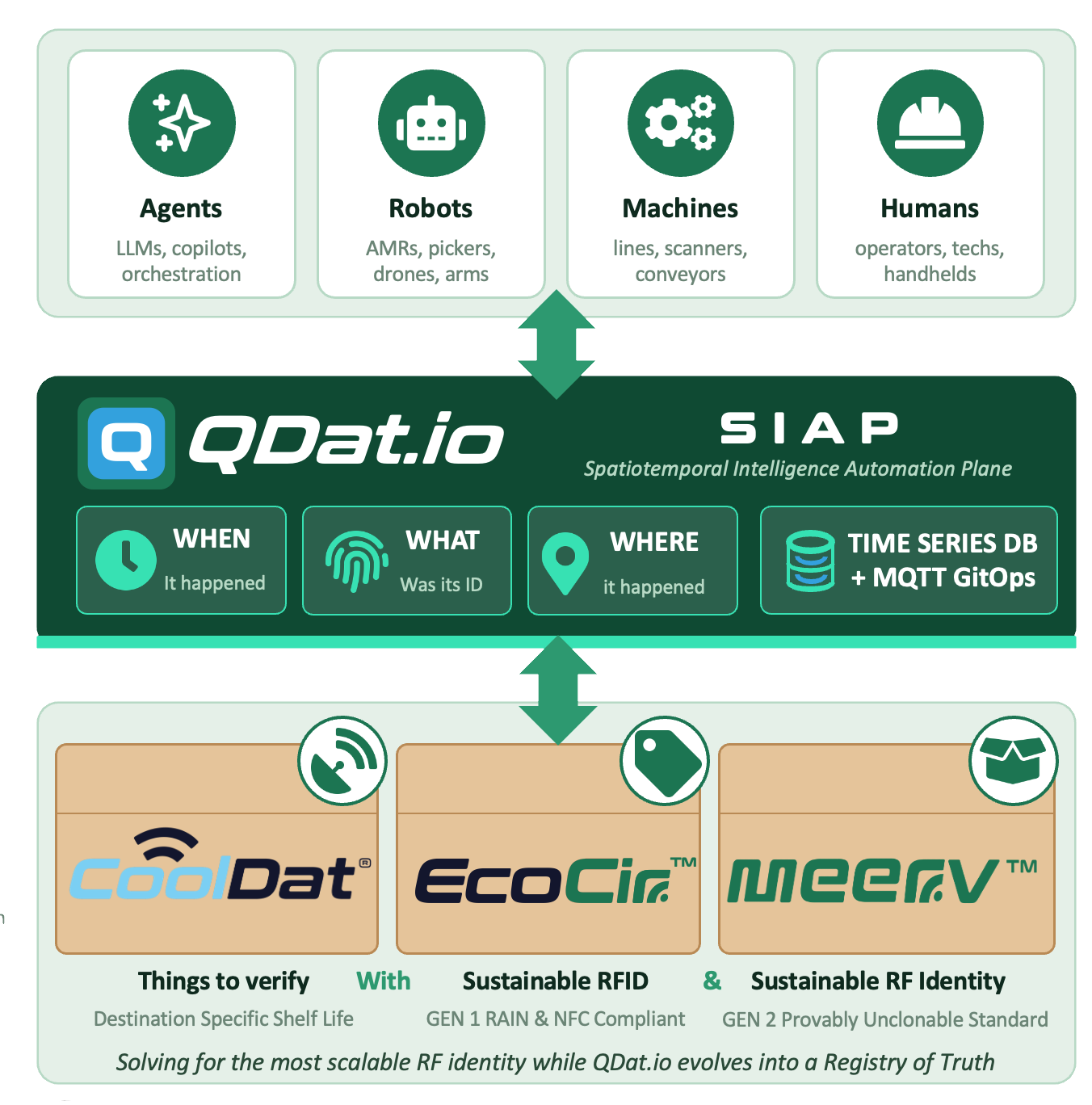
Agents, robots, machines, and humans on one plane.
The plane has no preferred actor. Whatever is acting on a Thing — software or steel, autonomous or operator-driven — talks to the Thing through the same interface.
Agents
LLM agents and copilots query item-level state and write decisions back over MCP and REST.
Robots
AMRs, pickers, drones, and arms subscribe to spatiotemporal events to know what they are facing.
Machines
Production lines, scanners, printers, conveyors, and refrigeration equipment publish state and consume per-item context.
Humans
Operators, drivers, technicians, and inspectors meet the plane through reader clients and dashboards.
Drop QDat.io into any system or agent.
The same spatiotemporal data is exposed through two equivalent surfaces. Pick whichever fits the consumer; back-office systems and AI agents read from the same source of truth.
RESTful API
OpenAPI-described endpoints for ERP, WMS, MES, BI, and any system that already speaks HTTP. Authenticated, paginated, versioned.
MCP server
A native Model Context Protocol interface so Claude, Cursor, Copilot, and any MCP-aware agent can read sensors, query alerts, and reason over item-level history without writing a custom integration.
QDatDroid puts the platform in every operator's hand.
Handheld and mobile readers running QDatDroid turn every field scan into a spatiotemporal event. The device reads RFID identity, inherits GPS coordinates, timestamps the event, and pushes it over public or private 5G mobile networks into QDat.io. Space is usually the missing field in operational data — QDatDroid closes that gap.
Open the QDatDroid product page on QDat.io/qdatdroidQDatDroid puts the platform in every operator's hand.
Handheld and mobile readers running QDatDroid turn every field scan into a spatiotemporal event. The device reads RFID identity, inherits GPS coordinates, timestamps the event, and pushes it over public or private 5G mobile networks into QDat.io. Space is usually the missing field in operational data — QDatDroid closes that gap.
Item-level cold-chain proof, label to AI.
Cooldat® is the Meerv-designed solution for cold-chain operations: a 5-element CoolKit with autonomous CoolTag temperature loggers, sustainable EcoTags, Zebra reader hardware, QDatFX and QDatDroid reader applications, and the Cooldat® cloud backend exposed through QDat.io.
CoolTag
Autonomous peel-and-stick UHF RFID temperature logger labels. 4096 encrypted on-chip samples, AES-128 authenticated, no return logistics.
Cooldat® cloud
MQTT, time-series storage, alarms and exception workflows — and the same REST + MCP surface as the rest of QDat.io.
Predictive AI roadmap
QCoolDat predictive shelf-life and QRecover predictive margin recovery, trained on the streams Cooldat® captures.
QDat.io. for food and beyond
Meerv Inc. is focussed on a sustainable electronics platform. Meerv Inc. also runs pilots under the QDat.io public-facing layer, supporting production workflows with a separate team of accomplished software engineers and support technicians. That split keeps Meerv Inc. focussed on its deeptech while preserving its ability to have an immediate impact in the market.
QDat.io lets you query profit in time and space.
If value decays with time, your operating system needs to know what actually happened before the window closes. QDat.io is especially strong in food because perishability, cold-chain exposure, traceability pressure, and thin margins make timing failures visible very quickly in waste, claims, compliance risk, and lost product value. That is why the first use cases focus on perishables: it is where spatiotemporal truth produces measurable ROI fastest.
Use cases and pilot paths
Start with item-level RFID, cold-chain, and logistics workflows before moving into broader traceability programs.
QDatDroid field execution
Mobile operator tooling for scan events, low-connectivity data capture, and practical pilot execution.
Cooldat® workflows
Pilot-ready cold-chain and quality workflows for temperature-sensitive operations.
QDat.io scales on Meerv's printed-electronics supply.
QDat.io's growth model is constrained by a hard physical fact: every additional item on the plane needs a tag. Meerv's sustainable printed electronics make those tags affordable at scale and reduce their lifecycle footprint. The platform and the supply move together.
Get started
Talk to Meerv about a QDat.io deployment.
Pilot programs and software-led rollouts go through QDat.io. Hardware, identity-tag manufacturing, and platform partnerships go through Meerv. Either entry point reaches the same team.